

An Employer of Record (EOR) in the Philippines is the definitive solution to this challenge. This guide delineates the critical components of EOR utilization in 2026—covering fiscal modeling, regulatory compliance, and the comparative frameworks necessary for informed executive decision-making.
What is an Employer of Record (EOR) in the Philippines?
An EOR functions as your legal infrastructure in the Philippines. While your organization maintains full autonomy over day-to-day operations and performance management, the EOR serves as the legal employer. This includes the full assumption of liability regarding labor law compliance, payroll administration, and the management of statutory benefits.

How it Differs from Alternative Models
To optimize your global human resources strategy, it is vital to distinguish EOR from secondary models:
- Payroll Providers: Limited to salary disbursement and tax filings. They offer no legal protection and do not assume employer liabilities.
- Professional Employer Organizations (PEOs): Typically operate on a co-employment basis. In the Philippines, this model often leads to ambiguous accountability for local labor disputes.
- Business Process Outsourcing (BPO): Focused on managed services where the provider retains control over the team’s workflow. In contrast, an EOR allows you to maintain direct management of your human capital.
Core EOR Obligations
- Execution of legally vetted employment contracts.
- Mandatory registration with SSS, PhilHealth, and Pag-IBIG.
- Administration of monthly payroll, tax withholding, and government remittances.
- Mitigation of compliance risks and regulatory reporting.
Scope Limitations (What an EOR Does Not Do)
- Management: The EOR does not direct daily tasks or project deliverables.
- Culture: Your organization retains complete control over company culture and KPIs.
- Strategy: The EOR acts as your administrative foundation, not your operational lead.
The Value Proposition: Remote Human Capital in the Philippines
In 2026, the Philippines has evolved from a “back-office” hub into a sophisticated global talent ecosystem. Enterprises are no longer merely outsourcing support; they are integrating IT specialists, certified accountants, healthcare analysts, and senior management into their core structures.
Strong Talent Pool
The country produces a high volume of specialized graduates annually across the STEM and Finance sectors. This provides global firms with access to elite expertise that is often scarce in domestic markets, ensuring a continuous pipeline of tech-savvy, adaptable talent.

English Proficiency
Consistently ranking among the top of Asian English proficiency indices, the Philippines offers near-native-level communication. For firms in the U.S., UK, and Australia, this translates to seamless collaboration, higher productivity, and zero communication friction.
Cultural Synergy
Filipino professionals demonstrate high alignment with international corporate hierarchies and Western business ethics. This cultural compatibility significantly reduces the “adjustment tax” often associated with global offshoring.
Proven Operational History
For decades, the Philippines has sustained the operations of Fortune 500 companies. This track record proves that the region is not just a cost-saving measure, but a reliable pillar for long-term organizational stability.
Compliance-Led HR Support
The primary barrier to global expansion is regulatory risk. EOR services eliminate this friction, allowing enterprises to focus on market share while the EOR manages the intricacies of the Philippine Labor Code.

Strategic Advantages of EOR Integration
For Your Company
- Accelerated Market Entry: Bypass the 6-12 month delay of entity registration; initiate hiring in 14 days or less.
- Capital Efficiency: Eliminate the overhead of physical offices, local HR departments, and legal counsel.
- Risk Mitigation: The EOR assumes full liability for misclassification and termination disputes.
- Operational Focus: Redirect executive bandwidth toward growth while the EOR manages the “red tape.”
For Your Workforce
- Institutional Benefits: Access to premium HMOs and mandatory government protections.
- Legal Security: Employment is backed by a fully compliant, formal contract.
- Professional Stability: Workers enjoy the status and protections of regularized employment.
Financial Modeling: 2026 Hiring Costs
Salary Benchmarks (NCR – July 2026)
While the minimum wage remains a baseline ($₱695$/day), professional roles demand competitive market rates:
- Junior Accountant: ₱25,000–₱35,000/mo
- Software Developer (Mid): ₱50,000–₱70,000/mo
- Senior Management: ₱100,000+/mo
Statutory Burden (Employer Share)
| Contribution | Rate/Cap (2026) |
| SSS | 10% (Capped at ₱3,500) |
| PhilHealth | 2.25% (Capped at ₱2,500) |
| Pag-IBIG | ₱100 (Standard) |
| 13th Month Pay | 1/12 of Annual Basic Salary (Statutory) |
Discretionary Benefits and Strategic Incentives
- Private Medical Insurance (HMO): Offering comprehensive healthcare coverage for employees—and often their primary dependents—is a benchmark expectation for professional-grade roles. This is a critical factor in risk mitigation and maintaining a healthy, resilient workforce.
- Operational Stipends: Strategic allowances for high-speed internet, remote office infrastructure, and meal subsidies ensure your distributed team possesses the necessary resources to maintain peak operational efficiency.
- Variable Compensation & Performance Incentives: Structuring annual bonuses or performance-based incentives aligns individual output with your enterprise’s overarching KPIs, fostering a culture of meritocracy and high accountability.
Navigating the Philippine Labor Code

STRATEGIC GOVERNANCE: PHILIPPINE EMPLOYMENT LAW ESSENTIALS
Employment Contracts & Probation
Defining Standards on Day 1 is Critical to Avoid Automatic Regularization


REGULAR
Indefinite tenure, Full rights

PROBATIONARY
up to 6 months,
perfomanace standards upfront

Fixed-Term/Project-Based
specific period/project
Working Hours & Compensation

Standard: 8 Hrs/Day, 5-6 Days/WK
Over Time: 125%
(hourly rate)

REST DAY WORK: ≥130%
(daily rate)

Night Differential
(10 PM-6 PM)
+10%
Mandatory Leaves


Service Incentive Leave (Sil):
5 DAYS
(after 1 year)

Maternity Leave:
105 DAYS
(with pay)

Paternity Leave:
7 DAYS
Solo Parent Leave:
7 DAYS
Holiday Pay Rules
Regular Holiday
(e.g., New Year, Xmas):
200%
Of Daily Rate If Worked
Special Non-Working
(e.g., All Saints):
+30%
Of Daily Rate If Worked
Termination & Due Process

JUST CAUSES
(Misconduct, Fraud, Gross Neglect)
AUTHORIZED CAUSES
(Redundancy, Retrenchment, Closure)

DUE PROCESS
(The Two-Notice Rule)
is MANDATORY.
Failure exposes Employer
to Financial Liability.
EOR Partners Ensure Compliance
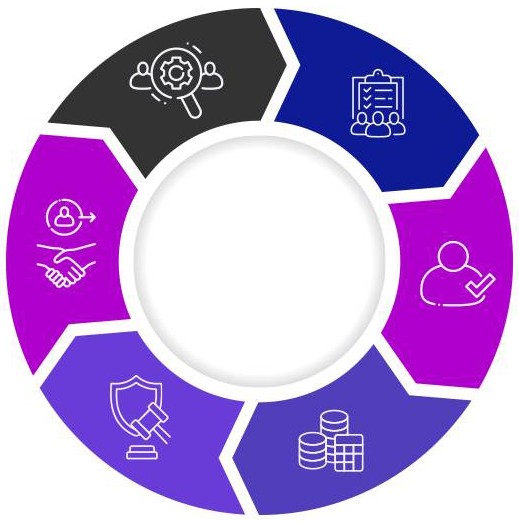
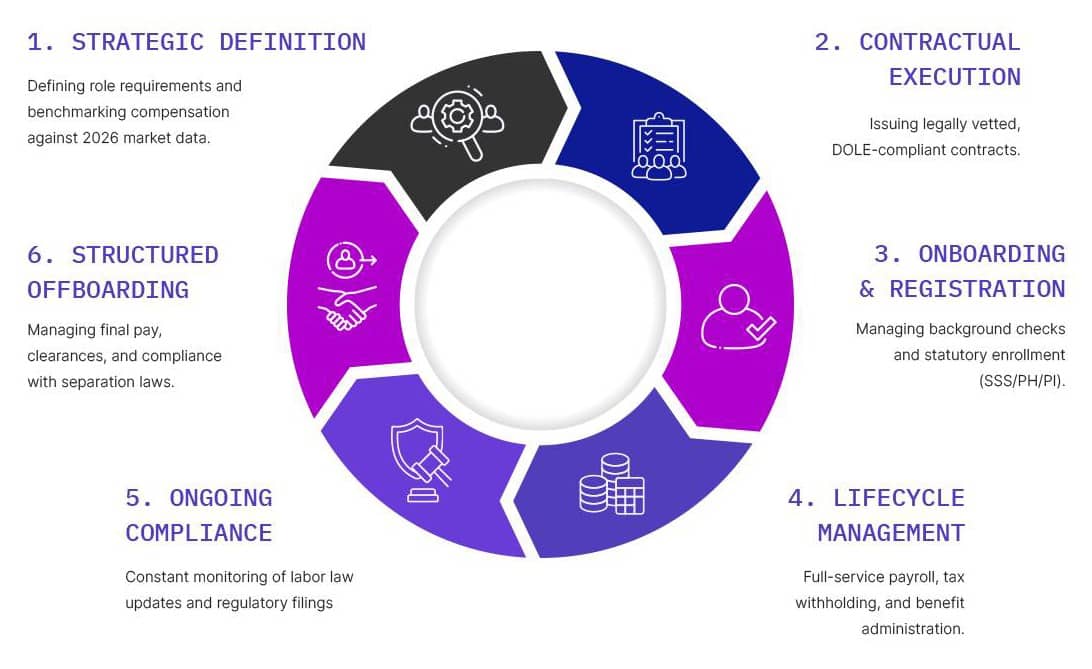
The EOR Engagement Lifecycle
1. STRATEGIC DEFINITION
Defining role requirements and benchmarking compensation against 2026 market data.
2. CONTRACTUAL EXECUTION
3. ONBOARDING & REGISTRATION
Managing background checks and statutory enrollment (SSS/PH/PI).
4. LIFECYCLE MANAGEMENT
Full-service payroll, tax withholding, and benefit administration.
6. STRUCTURED OFFBOARDING
Managing final pay, clearances, and compliance with separation laws.
5. ONGOING COMPLIANCE
Constant monitoring of labor law updates and regulatory filings
Comparative Framework: EOR vs. Alternatives
| Feature | EOR (Philippines EOR) | BPO Provider | Own Legal Entity |
|---|---|---|---|
| Who is the legal employer? | EOR | BPO company | Your company |
| Time to hire | 1–2 weeks | 1–3 months | 6–12 months |
| Level of control | Full control of day-to-day tasks | Limited (staff work within the BPO structure) | Full control |
| Minimum headcount | None | Usually 5–20 seats | Usually, 5–10 employees are needed to be cost-effective |
| Cost structure | Transparent EOR fee + salary | Seat fee + overhead | Entity setup cost + admin + salaries |
| Exit flexibility | High (easy to scale up/down) | Moderate (depends on contract terms) | Low (requires deregistration/liquidation) |
The Transition: From EOR to Legal Entity
Frequently Asked Questions
Is the EOR model legally recognized in the Philippines?
Yes. It is a recognized and legal framework for international companies to engage local talent. The EOR remains the employer of record for all state interactions, ensuring full compliance with DOLE regulations.
What is the effective 2026 markup for employer contributions?
Excluding service fees, an employer should budget approximately 15% to 20% above the base salary to cover 13th-month pay and statutory contributions.
Can we extend a 6-month probation?
No. Under the Labor Code, keeping an employee for more than 6 months without formalizing their status results in automatic regularization.
How is 13th-month pay handled?
It is a statutory requirement equivalent to 1/12 of the basic salary earned during the calendar year, typically disbursed by December 24th.